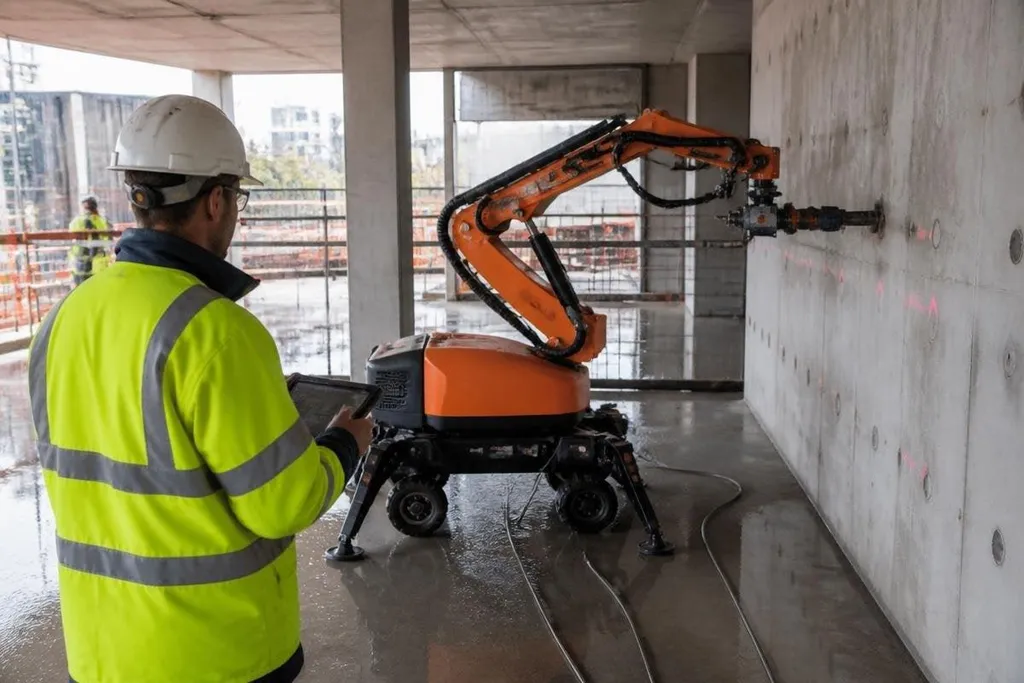
A construction robot may drill repeated holes, move materials, scan a work area, or lay blocks.
Those tasks sound narrow, but they can change who plans the work, who checks it, and where a worker spends a shift.
The useful question for a construction worker isn't whether a robot looks capable on video. It's which task leaves your hands, what new work replaces it, and who remains responsible when the machine stops.
- Robots fit best with repeated work in a fixed area.
- People still handle site changes, checks, repairs, and safety decisions.
- New roles will need machine setup, sensor checks, and task planning.
The first change is the task mix
Construction work combines repeatable steps with constant changes.
A robot can follow a planned path across a marked floor, but a real site may have new materials, uneven ground, blocked routes, or another crew in the same space.
That gives robots a clear place. They can take on work where the position, tool, and result stay similar from one cycle to the next. Drilling anchor holes is easier to automate than fitting an unusual pipe around a beam that was installed a few millimeters out of place.
The worker's role then moves toward setup and judgment. They may mark the work area, load the correct tool, check the result, and change the plan when site conditions shift. The physical task still matters, but the worker may perform fewer repeated motions.
This shift won't affect every trade in the same way. Floor scanning with a robot changes the work of a survey team. A robotic arm used for welding changes the work around steel fabrication. A system that carries materials changes how crews plan movement around the site.
Robots need a controlled work area
Construction robots work best when people can give them a clear zone, a known task, and a way to stop them. That means site planning becomes part of robot operation, not a separate office task.
Sensors help a robot detect people, objects, and changes in its path. They don't remove the need for human checks. Dust, poor light, reflective surfaces, vibration, and damaged markers can all affect what a sensor reports.
Teleoperation is another part of the picture. In this setup, a person sends commands or takes control when the robot reaches a case its software can't handle. The worker may spend less time doing the full task by hand, but they need to understand the machine's limits and know when to take over.
For construction companies, that creates a training question. A worker who knows the site may be better placed to run the robot than a person who knows the software but has never worked around concrete, steel, cables, or lifting equipment.
A construction robot changes a job only when the site record shows what it did and who remained responsible. Reports on construction robots from Robot24.com can tie that work to a named machine and task, leading to the next question: who carries responsibility?
Who carries the responsibility?
The machine can repeat a movement. It can't decide whether a wall is ready for the next task unless its maker and the site team have defined the checks that answer that question.
Responsibility will stay with people. Supervisors need to set work limits. Operators need to watch the machine and stop it when the area changes. Maintenance staff need to fix faults before a robot returns to work.
That may create safer work in some cases, especially where robots take on tasks in high, dusty, hot, or physically repetitive areas. The benefit depends on the full work plan. Moving a worker away from one hazard while placing another worker beside an unplanned machine path solves little.
The strongest opposing view is that robots could reduce the number of entry-level tasks through which new workers learn a trade. That concern deserves attention, because fewer hands-on tasks can mean fewer chances to build judgment under supervision.
I'd judge a construction robot by the training and control it gives the crew, not by how much work it removes from a video.
A site checklist
Before a company assigns a robot to a construction task, the crew should check:
- Task shape: Can the job repeat without frequent changes to position, material, or tool?
- Work zone: Can people mark and protect the robot's operating area?
- Human control: Who can stop the system, and who takes over when it fails?
- Result check: What physical measurement or inspection proves the task was done correctly?
- Training path: Will workers learn setup, sensor checks, fault handling, and repair requests?
- Trade effect: Which skills become more valuable after the robot takes the repeated motions?
Those answers show whether a robot helps the crew or adds another machine for people to work around. They also give workers a clearer say before a purchase becomes a site rule.
Construction robots will change jobs first by changing the tasks inside them. The open question is how well companies train the people who must run, check, and stop those machines.